
Today there was no travelling, just a day spent in Salisbury itself. The weather, which had been so beautiful all week, now turned a bit more seasonal and it poured with rain. We had been instructed to turn up at the Cathedral to be split into three groups, to go in turn on guided tours or self-guided walk-arounds.

We started with the walk-around, which gave us a chance to snoop around all the smart houses in the Cathedral Close – my favourite was the Bishop’s House.

As we emerged out of the Cathedral grounds and back out into the surrounding streets, I suddenly had a real Madeleine moment… – as there was my old school, St Osmund’s RC Primary! I went there for a few weeks when we arrived in Salisbury in 1955 and was horribly mocked for my northern accent by the nasty little boys. Then I got scarlet fever and measles in quick succession, was off school for 6 weeks and never went back. After the summer holidays Mum and Dad made the big decision to pay for us to go to the La Retraite Convent. No nasty little boys there…

Not only the school but the matching church were completely unchanged, built for an expanding Irish catholic population in 1847/48 and actually designed by Pugin in the gothic style – which means it is now a Grade II listed building.

We re-grouped back in the Cathedral and were allocated our guide, wearing the large green embroidered sash that my dad used to sport when he was a guide – immortalised in a knitted doll by one of his lady admirers at the Cathedral.

Today the Cathedral was being prepared for a School presentation event, so a large screen obscured the altar and east windows. But the wonderfully exotic font was still a marvel.
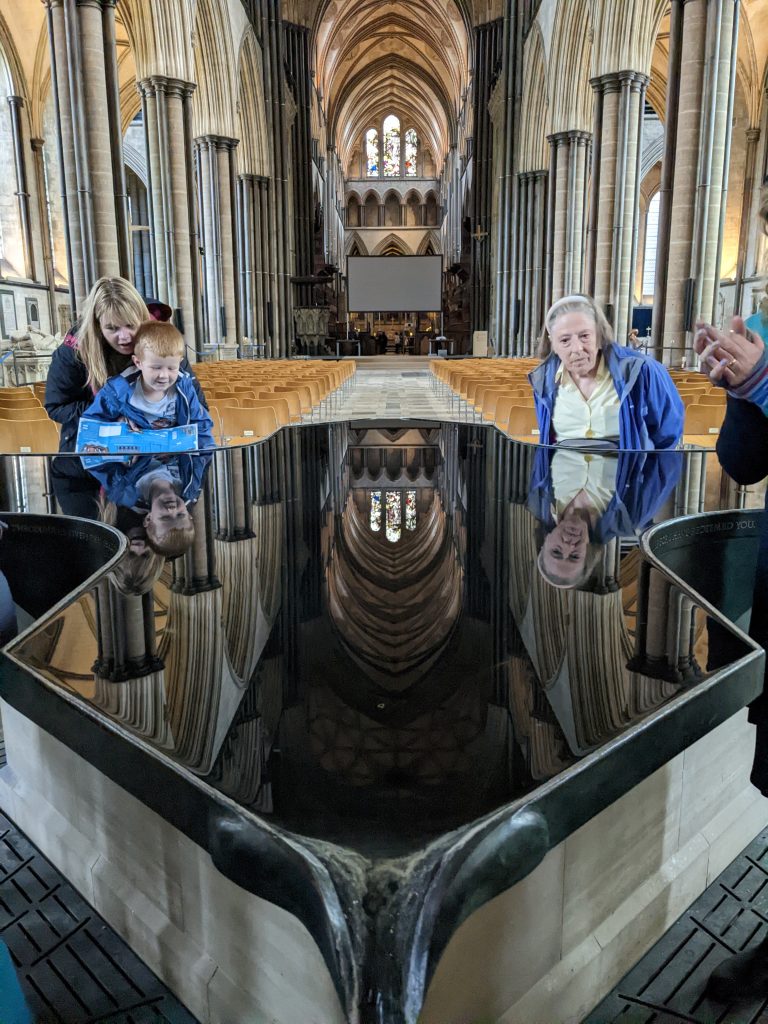
So, a few facts and figures about this beautiful Cathedral. The foundations were begun in 1220, and the city of Salisbury itself laid round it in a grid pattern under the direction of the Bishop. Amazingly, the east end was completed by 1225 and the finished building dedicated in 1228 – although the iconic spire was not added until 1320. If only we could build things this fast today.

One of the things that marks this building out from other cathedrals is that its basic structure has not become overcluttered with tombs and monuments. The sweeping lines of the columns and roof tracery remains clear. Obviously, it is a shame that the original polychrome colour scheme is long gone but most people would rather opt for the minimalist grey these days.

The chapter house, the meeting place for the cathedral’s senior clergy, has an elegant octagonal design. The picture below was taken in 1885. Today it has on display the best preserved of the four surviving copies of the Magna Carta. This Great Charter of Rights signed reluctantly by King John in 1215, was the first document to put into writing the principle that the king and his government was not above the law.

The final treasure that we heard all about was what Salisbury claims is the oldest working ‘modern’ clock in the world, dating from about 1386. The expert (but rather long-winded) guide explained that the work of the city was governed by the sounding of bells from the cathedral, calling the monks to prayer at set times throughout the day. But, very ingeniously, the mechanism could be adjusted to lengthen the time between each bell during the long days of the summer and to shorten it again in the winter. The clock is now in full working order, so we were able to hear the bell sound out high above us when he triggered the mechanism.

The final element of our cathedral visit was a behind the scenes tour of the stonemasons yard. The cathedral may only have taken 8 years to build originally, but since then work has never stopped on keeping it in good shape.
On the way to the yard we passed the elegant Chapter House on the outside.
We also spotted ancient ammonite fossils that had emerged from the quarried stone as it was being worked.

The methods for replacing worn or damaged stonework seem to have changed very little. Paper templates are prepared and each stonemason devises their own identifying mark, usually using their initials. In the past they would have been paid per piece of completed work. The workshop was full of quirky carvings of all kinds.

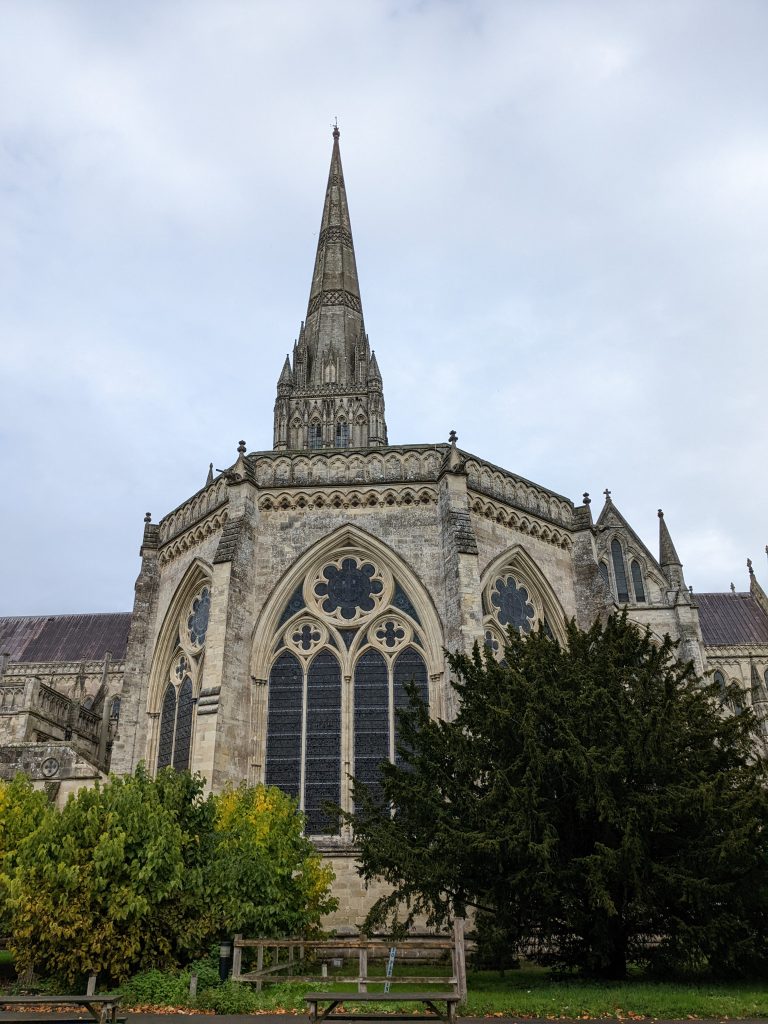
Later we spotted workmen dangling on ropes from the spire itself – what a great view they must have had.


The afternoon session was a visit to Salisbury Museum. A chance to see displays telling the story of some of the places we had spent the week visiting. Their very nicely presented Wessex Gallery had received Lottery Fund money for its refurbishment and opened in 2014.

Our final visit of the day was to St Thomas’s church in the middle of the town. This contains the largest and best preserved Doom Painting in the UK. Painted originally in 1470 it was whitewashed over during the reformation and only revealed again in 1819. Now fully restored to all its glorious colour it tells the tale of the Final Judgement all too vividly. On the left the good citizens and wise virgins are emerging from their graves and being led by angels to heaven. On the right, watched over by the devil, the sinners are heading down into the everlasting fires of hell. Watching it all is God the Father sitting on a rainbow. A speech-bubble in latin makes the moral absolutely clear: ‘There is no escape for the wicked’.

