
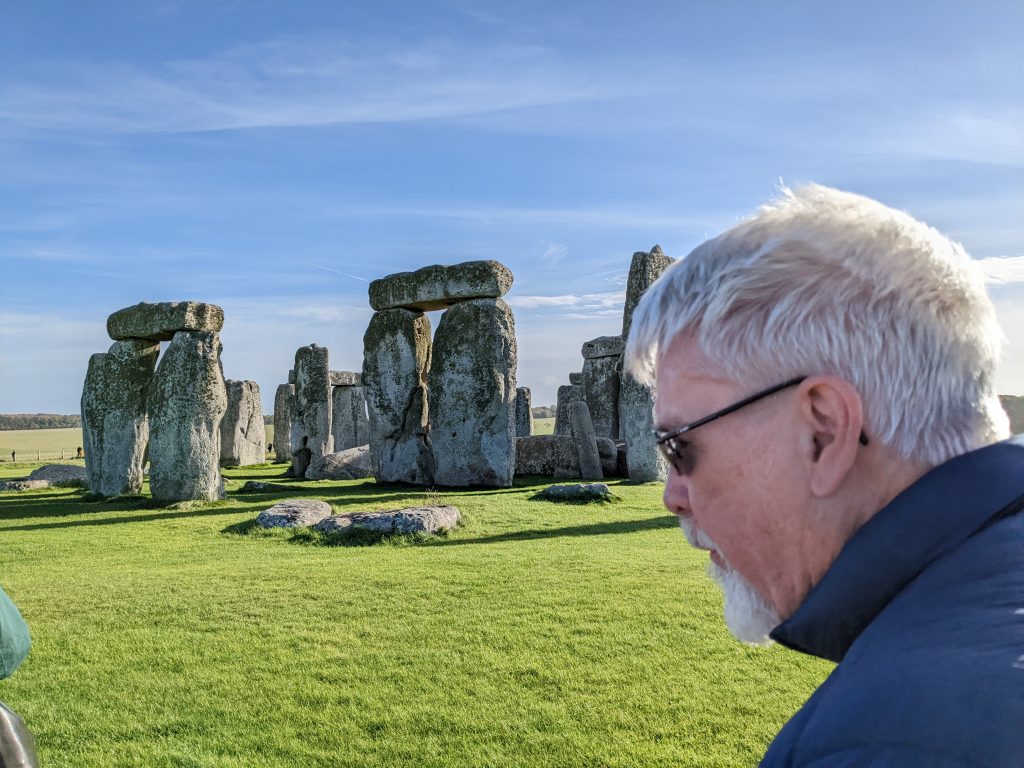
Stonehenge was our first destination – and our coach was waiting outside the gate at 9.30 before it had even opened. This meant of course that we had it completely to ourselves at first. The sky was blue, the sun shone and the skylarks were still singing (apparently, if the weather is good they just carry on breeding as long as they can).

Stonehenge was being used a special place long before any stones arrived. Some massive postholes big enough to hold posts 2ft 6in wide have been dated to around 8000BC, just after the ice retreated and Hunter Gatherer people made their way into England across the landbridge from Europe. The posts had been allowed to rot in place. Had they perhaps been totem poles, to signal meeting places for seasonal gatherings of people? The site of Blick Mead just a mile away was also clearly significant. Traces of shelters in the holes left by tree-throws have been found, and this special site had a magical pool of water which never froze in winter.

We started our circuit of the stones, crossing over the surrounding ditch, now hardly visible in the slightly sloping grass downland.
This ditch was dug around 3000-2620BC by the first people to farm the land rather than rely on hunting and gathering. These people had arrived in various waves from the continent from about 4000 BC. The ditch they dug had initially surrounded a circle of standing stones, marked now by concrete circles. These were probably brought from a dismantled circle monument of identical diameter at Waun Mawn in the Preseli Hills in Wales, dated to 3400BC. The quarry where these stones originated has also been identified.

(They now think that only 13 stones were moved from the circle at Waun Mawn, the rest came direct from the quarry, or perhaps an as yet unidentified stone circle.) The whole community was probably involved in moving the stones the 174 miles to the new site, probably using a wooden trackway and greased rails. Experiments have shown this works best.
It seems that they chose this site because the landscape of the treeless downland had some marked grooves and ridges, caused by regular freezing and re-freezing in the ace ages. By chance, these ridges were aligned in a North-East direction, perfect for sighting the rising sun at midsummer from the centre of the circle. Many of the stone-holes inside the ditch, and the ditch itself, contained handfuls of sprinkled cremation remains. Some of these bones have been scientifically identified as being from people who had spent much of their life in Wales, not on the Wessex chalklands.
When people think of Stonehenge today, they are not thinking of these original bluestones, standing only about 6ft above the ground, but the much larger 13ft high Sarsen Stones erected in pairs with massive stone lintels. Recent research has found the source of these stones, which is much nearer to hand, from West Woods south of Marlborough. Seventy-five stones would have been needed to complete the circle of uprights and lintel stones, built with mortise and tenon joints, as you would with wooden posts. The evidence of earlier wooden post holes in the site suggest wood was used before the stone on these internal elements.

The archaeologists have produced plans showing the dance of all these stones into different shapes and permutations across the site over time. But the emphasis on the summer solstice sunrise is maintained and strengthened by the addition of the Heel Stone outside the circle, in just the right position, and the creation of what is assumed to be a ceremonial Avenue, following the line of the ridges in the land and then branching south to finally arrive nearly two miles later at the River Avon in the valley below.
The peace of the morning was suddenly shattered by some army helicopters deciding to do some training flights overhead, presumably just for the hell of it.
The shaping of the stones is more pronounced on the inside and in the section facing the North East, the direction of the summer solstice sunrise. The massive inner horse-shoe of trilithons shows evidence of the stones being slimmed towards the top to maintain the perspective of straightness from the ground. The builders have also had compensate for the slope in the site as they completed the circle.
It was good to see the Stonehenge ravens still using the stones as the perfect cliff-face to perch on, as they have no doubt done for thousands of years.

We completed the circuit and got back on the buses to return us to the visitor centre and car park, now cunningly concealed half a mile away. Time for the delights of the pub in Amesbury

Our next stop was the Winterbourne Stoke Barrow Cemetery. The first long family burial mound on this site was built by the early farming community – this was now on privately owned land. But hundreds of years later after 2500 BC during the early Bronze Age, individual circular burial mounds began to be added to the site in a line of 11 barrows of various shapes, all aligned to the North West and South East and surrounded by an oval enclosure ditch.

Scott speculated that there had probably been many more in the adjoining field which had now been ploughed flat. The younger members of the group launched themselves to the top of the mounds. The wiser old hands, including me, stayed put. Mike found it easy to make it to the top – but the tussocky grass was harder to manage coming down, as he soon discovered, but fortunately without disastrous consequences, although his roly-polying down did alarm some of our fellow travellers…
Back on the coach we were heading North East now to the site of Durrington Walls, about two miles away from Stonehenge up the River Avon. This was a complex site with a long history. What you can see now is the remains of a huge henge – the largest in the country – angling down the slope to the Avon. The external bank and internal ditch of the henge are still visible and the road slices through the bottom of the site.

Recent excavations had discovered rectangular houses with central hearths underneath this bank which were dateable to between 2525-2470 BC, which was when the addition of the massive sarsen stones to Stonehenge was underway. Quantities of the grooved ware pottery characteristic of this period were also found and identification of their contents showed residues of pig fat and dairy products in varying concentrations at different parts of the site. The huge henge monument itself was clearly built over the original houses as the bank covers some of them. Inside they identified two structures with concentric circles of timber posts. The researchers have concluded that this site may have been used by the builders of Stonehenge and acted as a focus for communal feasting ceremonies at different times of the year and then eventually the building of this henge. Mysteriously, there is little evidence of stone axes at the site – but there are tantalising signs that a thin bladed metal adze was used in digging post holes that preceded the digging of the ditch of the henge. This could mean that metal objects were in use as early as 2450 BC, a hundred years before the Amesbury Archer was buried nearby with a copper knife. Perhaps the upsurge in cutting down huge trees to create palisaded enclosures and huge henges like this happened because the first magical copper tools had begun to appear in the UK from Europe? Such a frenzy of building projects does seem to indicate a society undergoing great change.
There is a ceremonial avenue connecting the henge to the River Avon in the valley below. This is aligned on the midsummer sunset. Professor Mike Parker Pearson has the theory that Durrington Walls is where the communal feasting took place before the cremated remains of important people were launched down the river Avon to arrive eventually (presumably accompanied) at a similar Avenue leading from the Avon up to Stonehenge. So, the land of the living is connected through the river to the land of the dead.
Just outside the banks of the henge to the south is Woodhenge. Here the remains of another set of concentric rings of posts of varying sizes (some huge) have been recreated in the landscape, giving a real feel of what it might have been like to experience it.

But there is still so much they don’t know. It feels like you should process round the circles towards the centre – but it is more of an oval than a circle and the patterning of the posts into large and smaller sets is sometimes confusing. Different kinds of deposits were left at different parts of the circuit. Was it roofed? Was there internal walling to make it more mysterious? Who was allowed in? All good fun to speculate. And some people have done so to ludicrous extremes!

And for one final new mystery associated with this site, in 2021 Professor Vince Gaffney announced the discovery of yet another 1.2mile circuit of enormously wide and deep pits which seem to surround this whole monumental landscape, perhaps marking a boundary to the sacred place and signposting it for visitors? All thrillingly mysterious! So much more to be found out in the future.
